|
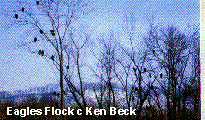
The American Bald Eagle is nothing if not resilient. In the 1960’s Rachel Carson drew attention to their devastating decline with her report that on the entire Mississippi River her counters found only 59 eagles. The effects of DDT, habitat destruction, and human persecution had taken a toll on a population, which once counted many thousands on the Upper River. The few remaining birds tended to winter near Union Dam in Keokuk, Iowa, where fish stunned by the turbulence and aeration of the water offered eagles easy foraging. Opposite Keokuk, along the Illinois shore, large trees, sheltered by the Iowa bluffs provided excellent perching and roosting sites.
Although DDT was banned in 1972, it wasn’t until 1985 that people started to notice a true increase in the eagle population. Pat Schlarbaum, at the time a Fish & Wildlife Specialist with the Iowa DNR, thought it was time to celebrate.
"The Keokuk Eagle Watch Days were really instigated as a celebration of the success of our wintering population of eagles," Pat says. "We had no idea the notion would catch on along the entire river. The Keokuk Watch now features nearly 500 wintering eagles, volunteer spotters, donated binoculars and spotting scopes. It’s exciting enough to draw viewers from around the nation. In addition, the public lectures and presentations by DNR personnel, volunteers from Raptor Rehab Centers, and the Army Corps of Engineers have provided our agencies with an outstanding opportunity to educate the general public about raptors, our birds of prey. Volunteers bring not only live eagles, but owls, hawks, and even peregrine falcons to the presentations." (continued below)
Pat considers the educational aspect to be the most important element
of the formal Eagle Watch Days. "Americans brought with them a European concept that raptors were basically ‘bad’ birds. That attitude made hawks, eagles, and falcons attractive targets for shooters. Farmers and ranchers often felt the birds threatened the young stock and poisoning was widespread. In fact, eagles are unable to lift anything heavier than five pounds."
"And we don’t just talk eagle lore at the presentations," Pat added, "it’s a great opportunity to explain, for example, how owls are ideally suited for night hunting—they can hear and instantly locate the beating heart of a mouse.
Eagles and hawks are day-hunters—therefore their eyes are sharp enough to read the print on a newspaper from the opposite end of a football field—that’s nearly seven times as sharp as human eyes! The fierce glare of an eagle’s eye is not because they are so fierce, but because the heavy brow serves as natural visors or sunglasses, for the day hunter."
While formal community Eagle Watch days are often limited to a single weekend per year, eagle viewing is possible nearly non-stop from December until early March. As waters freeze in Canada, northern Wisconsin and Minnesota, eagles flow down from to forage the open water found below dams and power plant. The population along the Mississippi may now be as high as 5,000 eagles.
The best eagle viewing occurs when it is cold enough to freeze large stretches of river so that eagles must concentrate at specific feeding areas. Mild winters mean eagles are more widely dispersed and spotting them is that much more difficult.
For eagle watchers, the combination of guides, equipment, and an opportunity to view "up close and personal" the many wintering eagles along the Mississippi River has proven irresistible. Eagle watch volunteers need to carefully monitor the interaction between viewers and eagles.
"Humans," says Pat Schlarbaum, "must also do their part. We need to learn to watch, but not disturb. We in Iowa feel strongly that we are only acting as hosts for these marvelous creatures. Come March, we want them returning to their nesting sites in Wisconsin, Minnesota, and Canada, in good health. Therefore we need to take a holistic view…protecting the quality of the water and the fish, the air, the trees." To that end, Pat offers these suggestions to eagle watchers:
Above all, do not disturb the birds. Eagles spend about 98% of their time roosting or perching. Loud noises, movement, trying to approach to closely will cause the birds to fly away, thus wasting valuable energy needed just to hunt and survive.
Use spotting scopes and binoculars so you can stay a good 100-400 feet away from the birds. They are visible with the naked eye, but to really view their bright yellow beaks and piercing eyes, the truly beautiful white head and tail feathers, binoculars are best.
Stay in a parked car when viewing so that your movements don’t frighten them. Birds are most susceptible when roosting and roosting areas must not be disturbed at night.
If you find an injured or dead eagle, leave it where you found it and call your local DNR. Though no longer endangered, eagles are still listed as threatened, and it is against the law to kill them for any reason.
Are eagles still around during the summer when we’re back
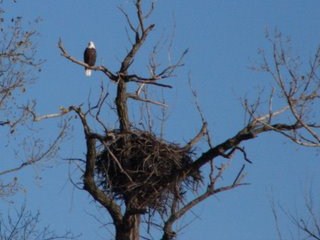
When boating, keep an eye open for nests—the largest on record was 10 feet wide, 20 feet deep and weighed two tons-—quite a feat for a pair of birds weighing 9 to 16 pounds!Eagle pairs return to the same nest, repairing and expanding it yearly. Nests will generally be located in the highest, sturdiest tree in the eagle pair’s territory. It is vitally important to stay far away from nests, particularly during the month of March, as the adults will abandon young if disturbed during the early "bonding" stage.
During the summer, eagles are generally found perched on bare snags hanging over the water, or in tall dead trees on a point of land or at the head of an island. They may also be soaring on thermals created by the bluffs, though they are easily confused with Vultures and Osprey. Generally, eagles will flap their long wings as little as possible. Vulture’s wings are carried in a high V shape while eagle wings stretch on a flat plane across the shoulders.
A close encounter between eagle and visitor is always a memorable experience. On one occasion a bald eagle swooped down beside me in a cruising paddlwheeler and rose with a large fish in its talons.
"Look! An Osprey!" a passenger cried out.
"No! No!" exclaimed an elderly gentleman, "I know darn well it’s not an Ostrich!"
Visiting Wisconsin, Iowa, or Minnesota?? Take your
All Volumes contain info on birding, wildlife viewing hotspots. Each highlights Geography, interpretive history and natural history attractions along the Great River Road."Having read DISCOVER! America's Great River Road, I cannot now imagine traveling the Mississippi River or the Great River Road without the maps, directions, narrative background, and detailed information they contain." ~ Reviewer, Heartland Boating Magazine
Volume 1 of Discover! St. Paul, Minnesota to Dubuque, Iowa. By River Author, Pat Middleton.
Isbn 09620823-8-4
THE indispensable guide to traveling the Mississippi River and the Great River Road. River access, B&Bs, riverside cafes, historic & natural history notes. Order by clicking tab below, or visit www.greatriver.com/order.htm